EIT Community New European Bauhaus · Co-create NEB 2027 · Thematic area: Food
Bairro
Comestível?
A neighbourhood that grows food on sealed ground — herbs and greens through the mild months, spirulina through the heat that would kill them. One system, two organisms, ten months.
The seasonal relay — why two cultures, not one
Project window: Feb → Nov 2027
The heat island is the problem the project addresses and the resource one half of the system runs on. That inversion is the argument — it explains why the technology is there instead of just placing it there.
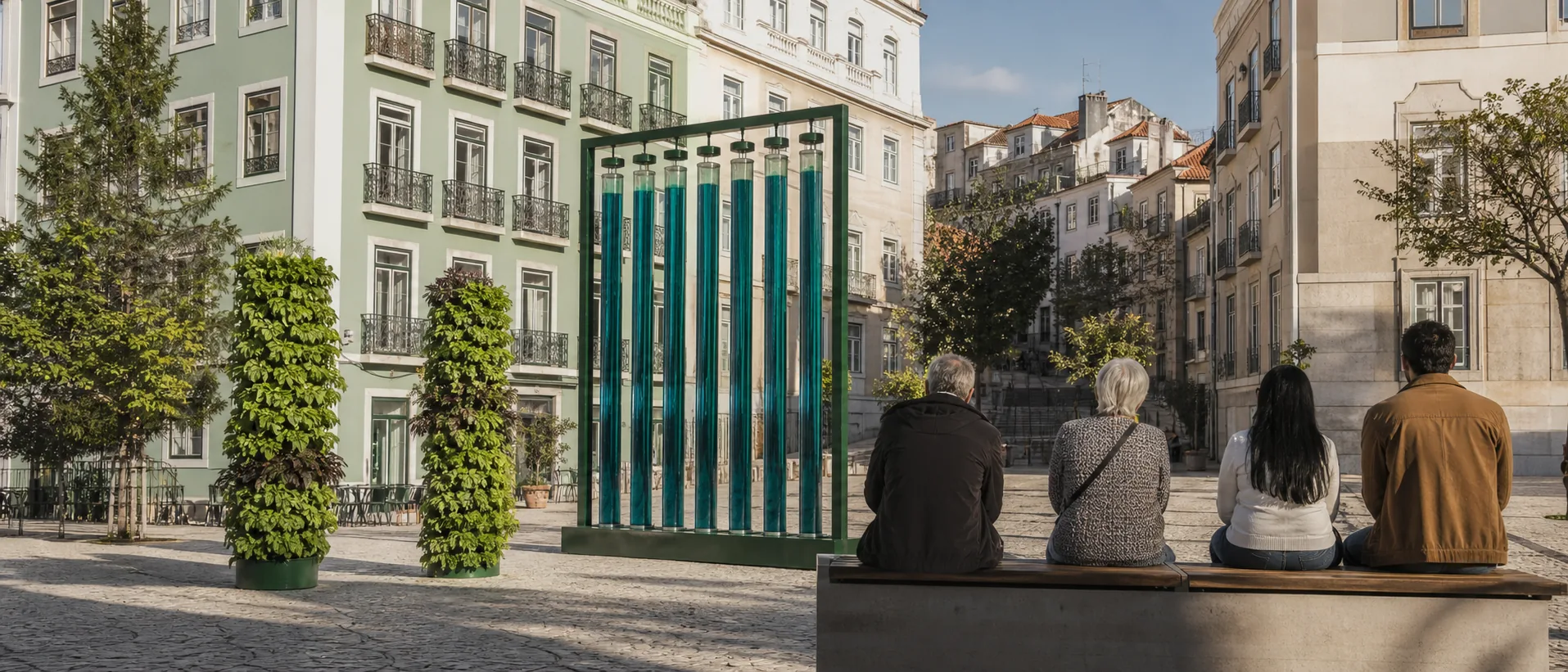
The one image the team and the freguesia will remember. It has to read as civic and permanent, not as a science-fair exhibit.
Image prompt
Architectural concept render, eye-level, late afternoon light. A small public square in a dense Lisbon neighbourhood, Portuguese calçada paving, four-storey pastel buildings with iron balconies. In the centre, a slender civic sculpture: a vertical frame of powder-coated dark green steel holding eight tall borosilicate glass tubes filled with luminous deep blue-green algae culture, fine air bubbles rising through them. Beside it, two waist-height vertical growing columns of basil and lettuce. Residents of mixed ages sitting on a low bench nearby. Photorealistic, wide-angle architectural photography, natural light, muted palette of sage green, petrol blue, warm limestone. No text, no logos, no people looking at camera.
01 — The call
What we are applying to
Two strands are open. We are proposing the larger one, which requires a municipal partner. If that partner is not signed by 15 September, we fall back to Connect NEB as a single applicant and cut the sculpture.
- Grant
- €49,300plus €8,700 co-funding we must find · €58,000 total
- Consortium
- 2–4 partnersat least one city, region or affiliated entity
- Duration
- 10 monthsFeb 2027 → Nov 2027, complete by 31 Dec
- Slots
- 3 per theme9 funded total, ranked within Climate / Mobility / Food
- Threshold
- 45 / 60below this, not fundable at any ranking
- Mandatory KPI
- 25 traineesassessed learning outcomes, signed attendance lists
02 — The concept
Growing where you can’t dig
Three components. The sculpture carries the aesthetics score, the columns carry the food story, the curriculum carries the mandatory KPI. Each one has a job; none is decoration.
Photobioreactor sculpture
A sealed vertical array of glass tubes running a spirulina culture. Publicly visible, publicly inaccessible. Biomass leaves the system in two forms: pigment for dyeing and printing workshops, and biostimulant fed back into the growing columns.
It is not a food dispenser. Nobody drinks from it, nobody opens it.
Growing columns
Eight to twelve soilless columns of herbs and leafy greens on sealed ground, each paired with one soil element — a reclaimed tree pit or wicking bed of pollinator planting — so the biodiversity argument holds and there is a living fallback if a pump fails in August.
Free harvest, governed by the Andernach traffic-light card system.
Six-module course
Twenty-five or more residents complete an assessed programme: nutrient chemistry, EC and pH, transplanting, pump and reservoir maintenance, harvest hygiene, culture monitoring. Certificates issued.
This is not outreach. It is the KPI on which half the final payment depends.
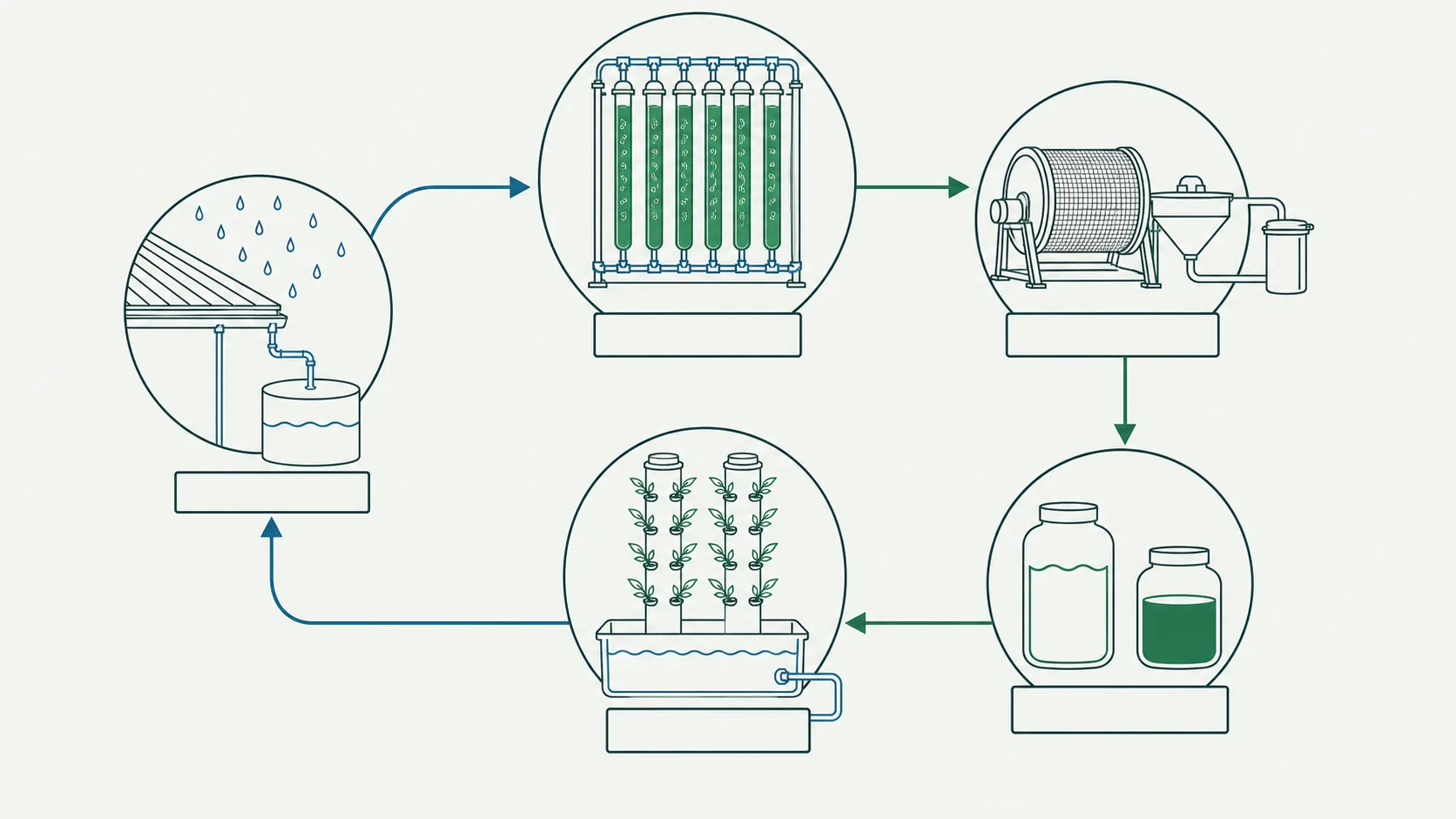
Shows spirulina biomass leaving the reactor as biostimulant and pigment, water recirculating, rainwater entering, harvest leaving. This is the circularity evidence for the Sustainable value — evaluators will look for a loop, not a list.
Image prompt
Clean technical system diagram, flat vector, no perspective. A closed material loop with five labelled nodes connected by directional arrows: (1) rainwater capture from adjacent roof, (2) sealed spirulina photobioreactor tubes, (3) harvest and filtration station, (4) biostimulant and pigment outputs, (5) hydroponic growing columns returning to water reservoir. Thin 2px line weight, generous white space, muted palette: deep petrol green #0B2422 lines on pale sage #EDF1EA ground, spirulina green #1F7A55 and phycocyanin blue #14506F to distinguish the two circuits. Small sans-serif labels, no icons that look like clip art, engineering-drawing sensibility. No 3D, no gradients, no drop shadows.
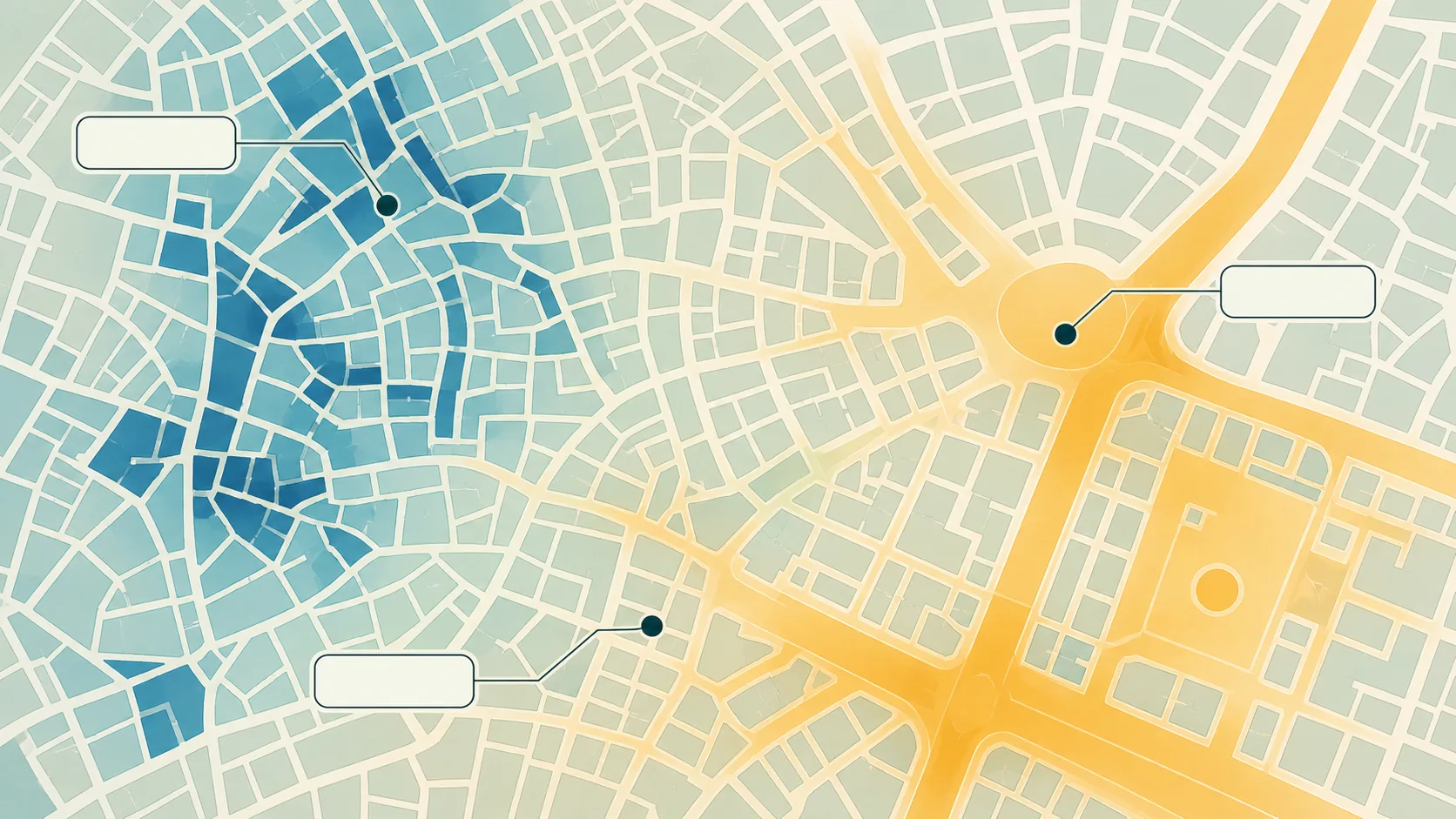
Needs to justify site selection with evidence, not preference. Anchor it to the TemperaturasLx citizen-science readings — surface temperatures reached 58.3 °C on exposed bituminous paving against roughly 30 °C on shaded calçada.
Image prompt
Stylised cartographic infographic of a dense central Lisbon neighbourhood, top-down abstracted street plan, no satellite imagery. Building blocks in flat pale grey-green, streets left as negative space. Surface-temperature intensity shown as soft graduated overlay from cool teal through to saturated amber on the widest unshaded streets. Three small circular markers indicating candidate installation sites, each with a thin leader line to a blank label box. Restrained editorial cartography, palette of pale sage #EDF1EA, petrol #0B2422, amber #D69B12, teal #14506F. Flat vector, no 3D buildings, no photographic texture, no place names.
03 — Scoring
Where the 60 points are
Every section of the application maps to a scored criterion. Write to the grid, not to our own enthusiasm.
| Criterion | What earns it here | Points |
|---|---|---|
| Fit with programme | Physical transformation of a public space, delivered with the freguesia | 5 |
| Need and relevance | Measured surface heat, no soil, tenant-heavy population with no growing space | 5 |
| NEB alignment | Sculpture answers Beautiful; loop answers Sustainable; free harvest answers Together | 5 |
| Gender and diversity | Course design, recruitment targets, managerial roles named in the team table | 5 |
| Target groups | Named building clusters, school partnership, outreach in Portuguese | 5 |
| Outcomes and outputs | Measurable: units installed, kg harvested, trainees certified | 5 |
| Durability and transferability | Our weakest point. Needs a signed maintenance commitment and a build manual | 5 |
| Team capacity | Five people, roles split, local ties evidenced | 5 |
| Execution plan | Ten months, three components — must read as achievable, not ambitious | 5 |
| Co-creation methodology | Co-design workshops before fabrication, not after | 5 |
| Risk management | Culture crash, food safety, permits — see below | 5 |
| Budget | Fabrication vs participation split defensible line by line | 5 |
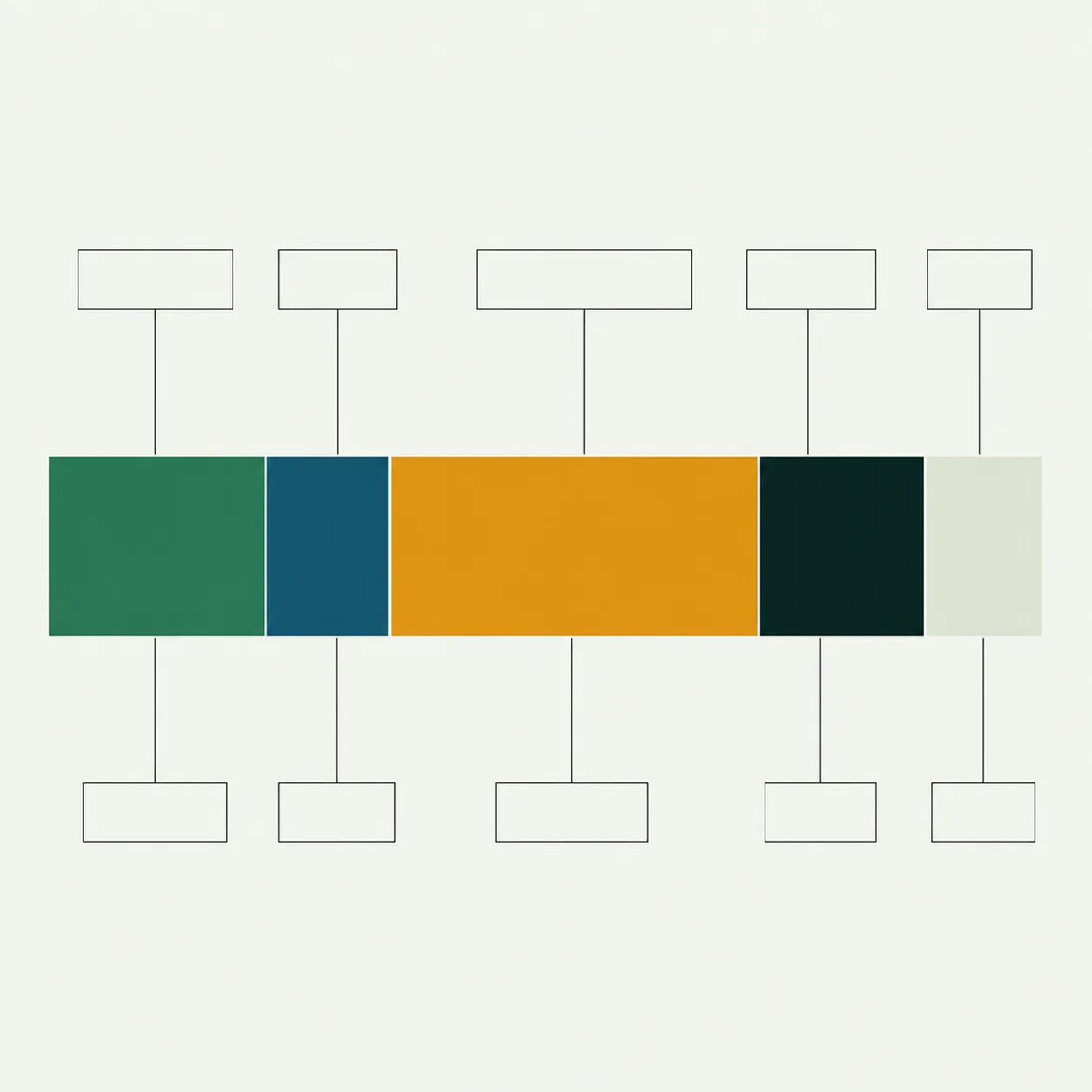 Fabrication
€12,76022%
Staff time
€7,54013%
Participation
€21,46037%
Materials
€9,86017%
Contingency
€6,38011%
Splits €58,000 across fabrication, participation programme, staff time, materials and contingency. The reviewer is checking that participation is not a rounding error next to hardware — keep fabrication under 40%.
Image prompt
Minimal editorial budget chart, square format. A single horizontal stacked bar or a clean set of nested rectangles dividing a total into five labelled segments of differing width, with the largest segment clearly not the first. Thin hairline separators, generous margins, small monospace labels with percentages set outside the bar on leader lines. Palette: spirulina green #1F7A55, phycocyanin blue #14506F, amber #D69B12, petrol #0B2422, pale sage #EDF1EA ground. Swiss editorial data-visualisation style, flat, no 3D, no pie chart, no drop shadows, no legend box.
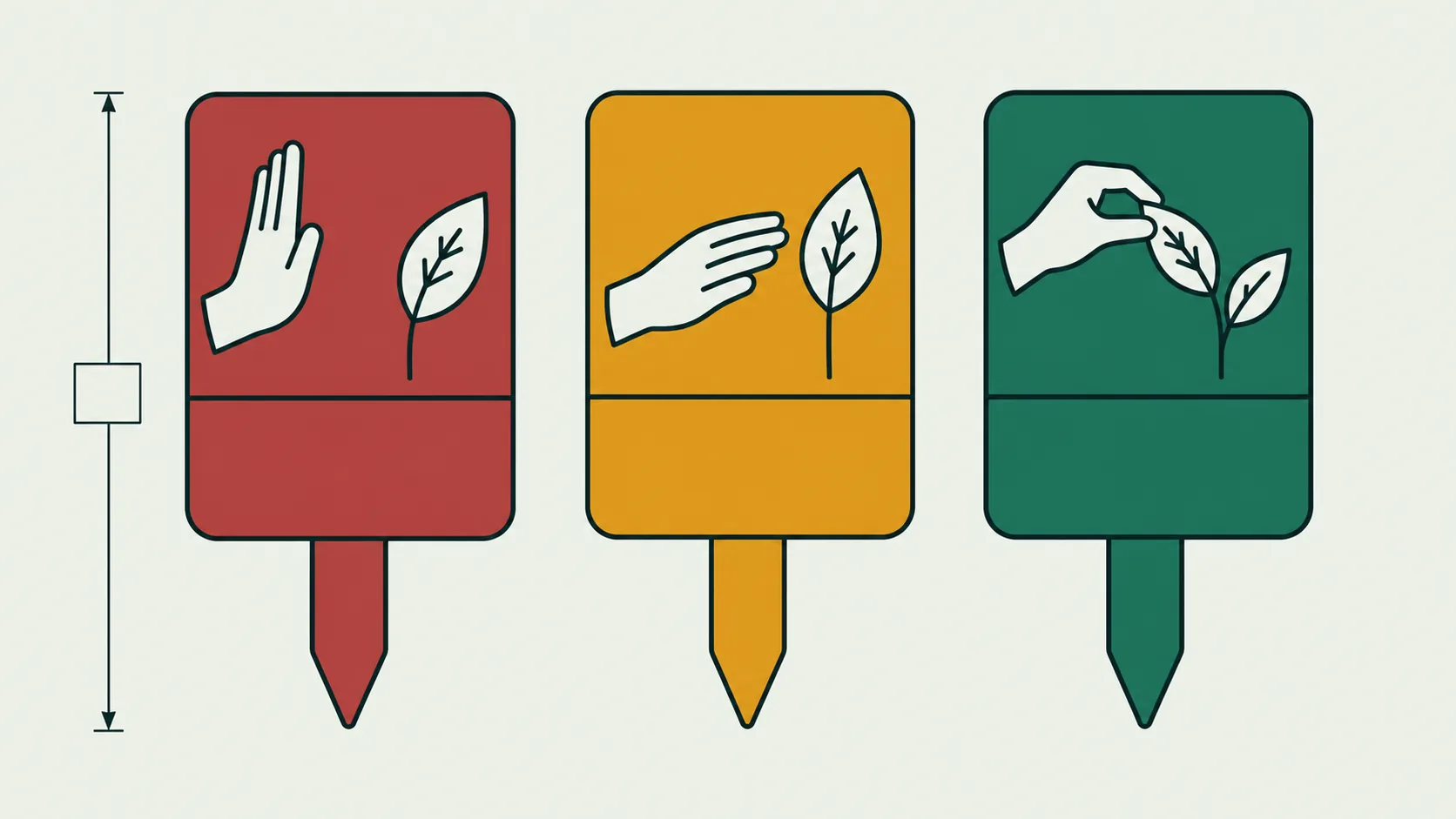 Not readyLeave it to grow
Only if neededTake a little
Ready — take somePick outer leaves
60 cm
The answer to “won’t people strip it bare?” Adapted from Andernach: red means not ready, yellow means only if you really need it, green means take some. Needs a Portuguese-language version before the co-design workshops.
Image prompt
Signage design sheet, flat vector, three-up layout. Three weatherproof planter cards shown face-on in a row, each a rounded rectangle on a short stake: first in muted brick red, second in amber, third in spirulina green. Each card carries a simple pictogram of a hand and a leaf at differing states, plus a blank band beneath for text. Below the row, a thin dimension line indicating card height. Clean product-design presentation on pale sage #EDF1EA ground, flat colour, no photographic texture, no lettering, no words anywhere in the image.
04 — Risk
What kills this
These go in the application, openly. A named risk with a named mitigation scores; an unmentioned risk found by the evaluator does not.
Culture crash in August
Severity: high · Likelihood: mediumA failed culture is brown sludge in a public square, photographed for the final deliverable. Mitigation: modular swappable tubes, a backup culture maintained indoors, weekly monitoring built into the course.
Food safety on spirulina
Severity: critical · Likelihood: low if designed outOpen culture risks contamination by microcystin-producing cyanobacteria. Mitigation: sealed system, no public access to liquid, primary outputs non-food, any edible harvest only under supervision with lab testing by a partner.
No municipal signature by mid-September
Severity: fatal to this strandCo-create needs a city, region or affiliated entity, plus documentary proof attached at submission. Missing annexes are rejected at admissibility, not reviewed. Mitigation: parallel Connect NEB draft held ready.
Scope
Severity: high · Likelihood: highThree technologies means three failure modes for five people in ten months. Mitigation: the sculpture is the hero, the columns are supporting, and anything that does not serve a scored criterion gets cut this week.
Year-two abandonment
Severity: medium · scored directlySoil survives neglect; a pump-fed system dies in three days. Mitigation: solar-powered pump with battery, plus a written maintenance commitment from the partner before we submit.
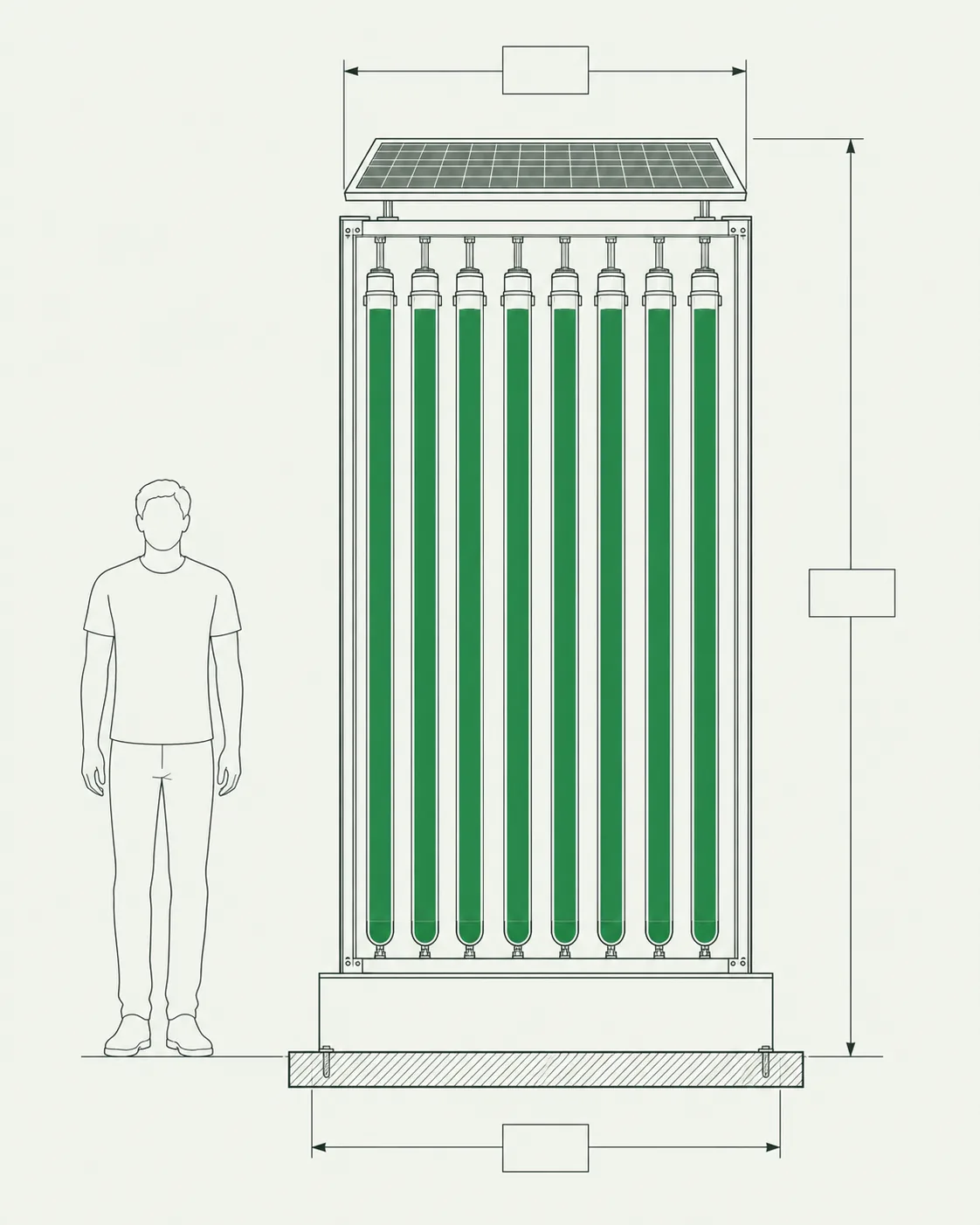
Front elevation with dimensions, tube count, reservoir position and the solar panel. Needed for the freguesia conversation — they will ask how tall, how heavy, how it is fixed, and who opens it.
Image prompt
Technical elevation drawing, portrait format, orthographic front view, no perspective. A freestanding public sculpture roughly 3 metres tall: a slender rectangular steel frame holding eight vertical glass tubes side by side, a concealed base housing a sealed reservoir, a small tilted solar panel on top. Thin uniform line weight, dimension lines with arrowheads and blank measurement boxes, hatched section indication at the base plate. Drafting-blueprint sensibility but on pale sage #EDF1EA ground with deep petrol #0B2422 linework, tubes filled with flat spirulina green #1F7A55. A scale human silhouette at left in outline only. No text, no numerals, no title block.
 M1 Water & nutrients
Practical check
M2 Culture handling
Practical check
M3 Harvest & filtration
Logged harvest
M4 Food safety
Written test
M5 Maintenance
Rota sign-off
M6 Running a workshop
Peer-led session
Feb
Mar
Apr
May
Jun
Jul
Aug
Sep
Oct
Nov
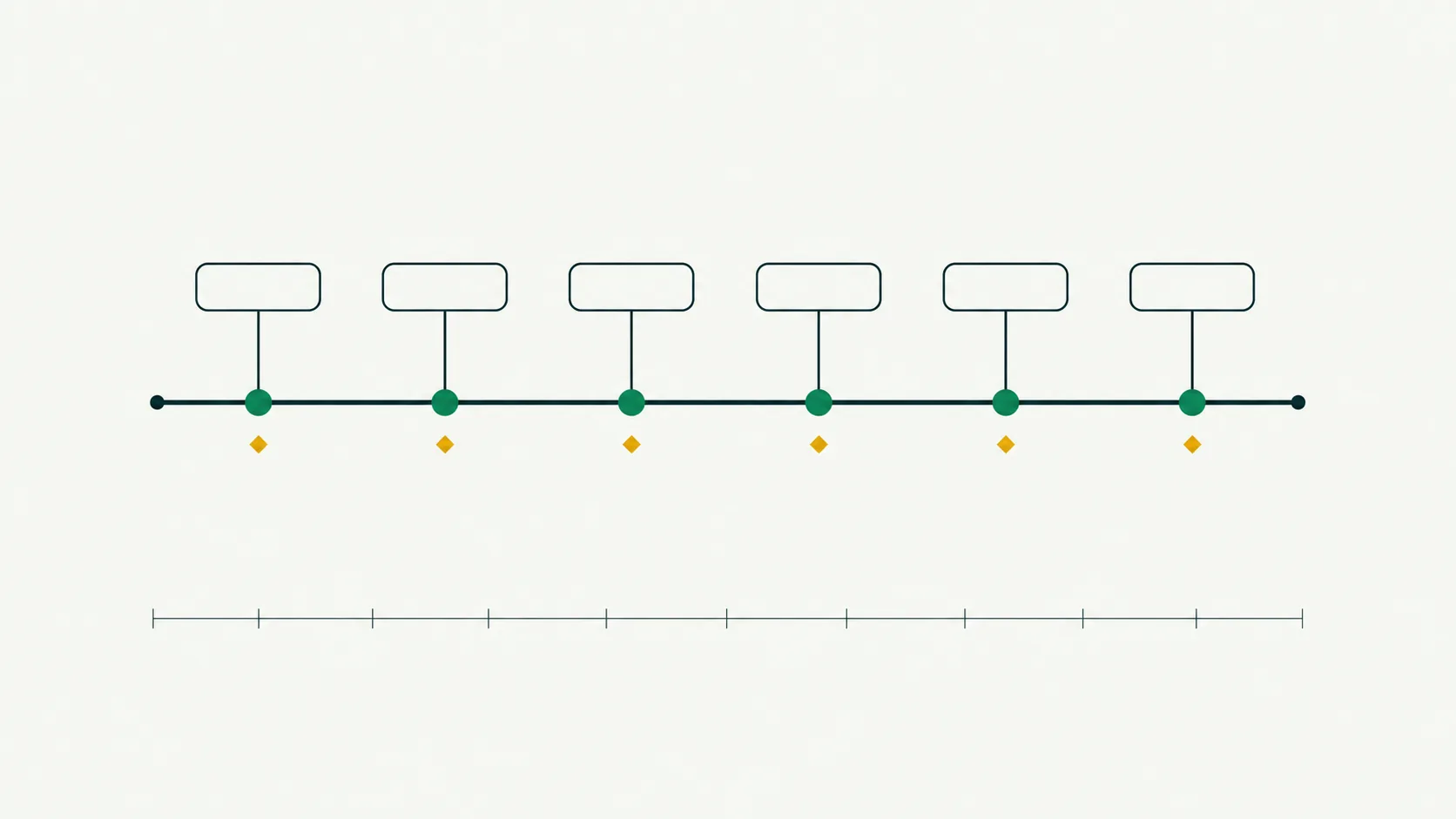
Six modules across ten months with the assessment point marked on each. This doubles as the KPI evidence annex, so every module needs a stated learning outcome and a way of checking it.
Image prompt
Curriculum timeline infographic, landscape, flat vector. A horizontal spine running left to right with six evenly spaced nodes above it, each node a small circle with a blank label plate and a tiny secondary marker beneath indicating an assessment point. A thin band along the bottom showing ten equal month divisions. Restrained editorial style, hairline rules, generous white space, palette of pale sage #EDF1EA ground, petrol #0B2422 spine, spirulina green #1F7A55 nodes, amber #D69B12 assessment markers. No icons, no illustrations of people, no text.
05 — Between now and submission
Five weeks
Owner column is blank on purpose. We fill it in the meeting.
- This weekRegister for a PIC on the EU Funding & Tenders Portal, then register the org in the EIT Urban Mobility portal and complete the Partner Information Form.Owner: ____
- This weekApproach the freguesia and Gebalis. Ask directly whether they qualify as an affiliated entity and whether they will sign.Owner: ____
- 3 SepAttend the online information session, 11:00 CEST. Ask the affiliated-entity question on the record.Owner: ____
- Week of 7 SepLock the site. Draft the six modules with assessable learning outcomes.Owner: ____
- Week of 14 SepConfirm the €8,700 co-funding source in writing. Generate the infographics in this document.Owner: ____
- 15 SepGo / no-go on Co-create. If no signature, switch to the Connect NEB draft and cut the sculpture.Owner: ____
- Week of 21 SepFull draft into the portal. Attach the declaration of affiliation. Internal review against the scoring grid.Owner: ____
- 30 SepSubmit by 17:00 CEST. Late submissions are not considered, and missing annexes are rejected before review.Owner: ____
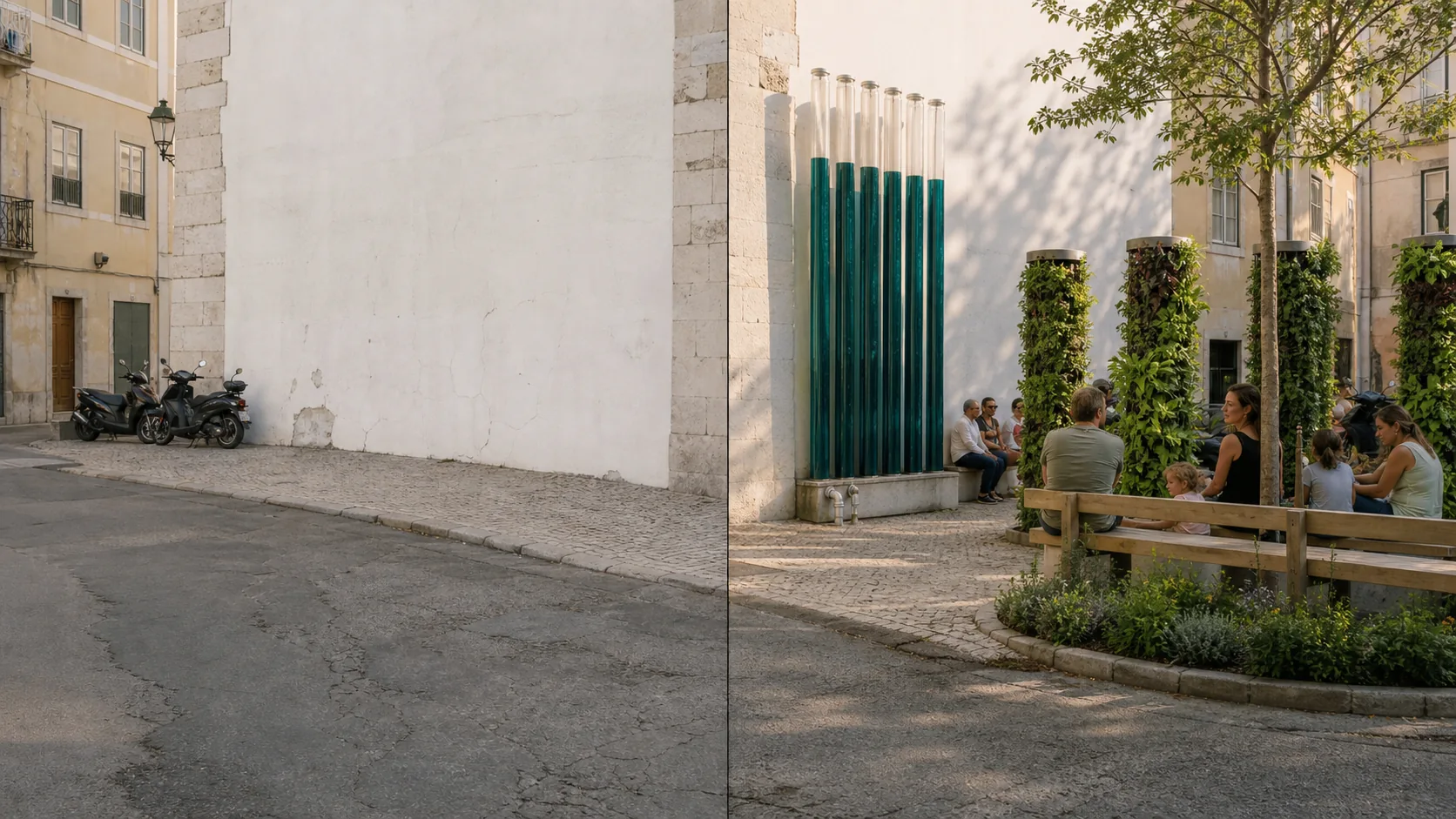
Mock this now so we know what we are aiming the camera at in November 2027. The public-space improvement deliverable requires photographs of the site before and after, showing how the space sits in its context and how people use it.
Image prompt
Split-frame comparison image, single landscape canvas divided vertically down the middle, identical camera position on both sides. Left half: a bare residual corner of a Lisbon square, cracked asphalt and calçada, parked scooters, a blank rendered wall, no greenery, harsh midday light. Right half: the same corner with a tall glass-tube algae sculpture, several vertical planted growing columns, a reclaimed tree pit with low planting, a bench, people of mixed ages using the space in late afternoon light. Photorealistic documentary photography, consistent lens and framing across both halves, muted natural palette. No text, no labels, no arrows, no watermark.
06 — For the meeting
Open decisions
Co-create with a partner, or Connect on our own? Everything else follows from this, and it has a hard deadline of 15 September.
Does the sculpture stay if we drop to Connect? On €18,000 it crowds out the participation work that carries the points.
Which bairro, and do we already have a relationship there? “Proximity through direct belonging or a long-term relationship” is scored language.
Where does €8,700 of co-funding come from? BIP/ZIP closed on 14 August, so it is not that.
Who owns the culture in month seven, when the novelty has worn off and someone still has to check the pH on a Sunday?